
Osaka’s ‘yellow streets’ almost eliminate illegal solicitation
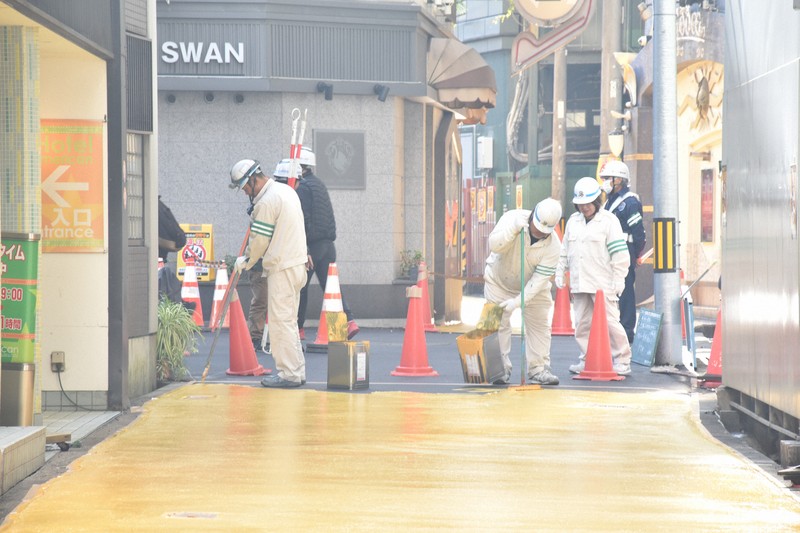
A notorious narrow street nestled in Osaka’s vibrant Umeda nightlife district, long whispered about by locals as a hub for prostitution, has undergone a striking transformation.
Residents and police have joined forces, employing a behavioral economics strategy inspired by a Nobel Prize-winning economist, alongside supportive measures for women involved, to reshape the environment of this troubled lane.
Just a short distance from the bustling main thoroughfares near Osaka’s Kita Ward, a secluded 100-meter stretch of municipal road, flanked by hotels and commercial buildings, had become a well-known location for illicit encounters.
Its hidden nature attracted a constant stream of visitors, prompting neighborhood families to explicitly warn their children to avoid the area entirely.
According to the Osaka Prefectural Police, the presence of women believed to be engaged in prostitution on this particular street began to increase around 2022. Social media posts subsequently amplified its notoriety, widely labeling it a “prostitution hotspot.”
Between late 2023 and late November 2024, police arrested or referred 30 individuals for prostitution-related offenses, primarily for soliciting customers.
The Sonezaki Police Station, responsible for the area, increased patrols and collaborated with locals to erect posters declaring, “Waiting to solicit customers is illegal.” However, these traditional law enforcement efforts yielded limited visible improvements.

Starting in the summer of 2024, the prefectural police initiated discussions with Osaka Municipal Government officials and local residents, seeking expert advice to develop more effective strategies.
Their chosen approach drew upon “nudge theory,” a concept in behavioral economics developed by Nobel laureate Richard Thaler.
“Nudges” involve subtly prompting or gently influencing individuals towards making better choices by analyzing and influencing their behavioral motivations, without resorting to forced compliance.
Professor Takahito Shimada of Shiga University, a former head of the crime prevention research division at the National Research Institute of Police Science, collaborated on this innovative initiative.
Shimada explained that narrow spaces surrounded by tall buildings often do not induce stress, even during extended stays, effectively making the problematic street a “hidden spot” where women could solicit clients with less fear of observation.
Based on Shimada’s analysis, authorities implemented a visually striking intervention: painting the street surface yellow, a color commonly associated with caution and warnings. The intention was to subconsciously alert visitors and discourage them from lingering in the area.
Art students from a nearby vocational school were commissioned to create a series of ten illustrations depicting fish swimming towards the street’s exits.

These aquarium-themed images were installed along the pavement, aiming to provide a visual cue that would further motivate pedestrians to move through the area quickly.
Locals reportedly welcomed this creative addition and the road painting and artwork installation were completed in December 2024.
To assess the impact of these “nudge” interventions, plainclothes officers from Sonezaki Police Station conducted patrols four times daily for a week.
The results were significant: the average number of people lingering per patrol dropped dramatically from 7.43 in November 2024 to just 0.86 in February 2025.
Professor Shimada noted that utilizing nudge theory to combat prostitution is a globally unprecedented approach, highlighting the groundbreaking nature of this initiative.
Masafumi Fujino, 79, a leader in neighborhood crime prevention efforts, lauded the interventions, stating, “The street has become brighter, and people in our community are talking about how much easier it feels to pass through now.”
Police plan to continue patrols and monitor the long-term effectiveness of these changes.
While the initial results of the environmental changes appear promising, some have raised concerns that simply displacing women from one street might merely shift the issue to other locations.
During public consultations, both locals and police emphasized the importance of addressing the underlying factors that force women into prostitution.
In an effort to provide more direct support, Sonezaki Police Station began distributing postcard-sized “yellow cards” directly to women frequenting the street in March 2025.

While these cards explicitly warn that prostitution and solicitation are illegal – hence the “yellow card” analogy – they also include compassionate messages expressing care and offering support: “Your body and heart matter. There are people who genuinely want to protect you.”
Officers from Sonezaki Police Station, having witnessed instances of assault and robbery against women accompanying clients into nearby hotels, were motivated by a desire to prevent further harm.
The cards carry a heartfelt message: “We don’t want you to feel afraid on these streets. Value yourself and stay safe.”
Alongside these cards, police are distributing flyers produced by the city of Osaka that provide contact information for accessible counseling services available through email and social media, with the hope of connecting women with resources should they decide to seek alternative assistance and leave prostitution.
Ryo Kitagawa, former head of Sonezaki Police Station’s community safety division, reflected:
“Previously, there were cases where women we’d questioned simply returned to the street. While we remain vigilant in eliminating street prostitution, we also want the area to become a supportive environment for women facing difficult circumstances.”
Source, Images: Mainichi
This post may contain affiliate links, and Essential Japan may earn a commission if you purchase through them.